

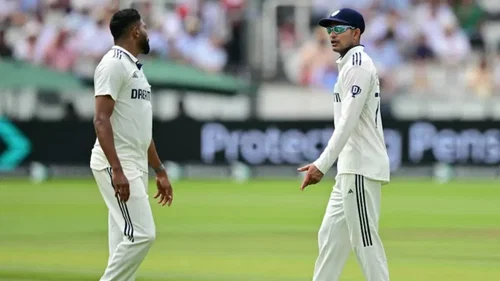
India head coach Gautam Gambhir and captain Shubman Gill made a bold choice name by leaving Mohammed Siraj out of the enjoying XI for the first Check in opposition to New Zealand on the Basin Reserve in Wellington on Thursday. India opted for 4 specialist pacers after successful the toss and choosing to bowl.
Siraj’s omission got here regardless of his expertise and strong document in overseas situations. He featured only within the fifth ODI of India’s New Zealand tour, taking two wickets and helping secure a 22-run victory. Nonetheless, his recent Check returns and workload gave the workforce management causes to consider different options.
1. Mohammed Siraj’s Latest Check Numbers and Workload Raised Issues
Mohammed Siraj’s recent performances in main Check collection made his omission easier to know. Though he has been a reliable overseas bowler, his financial system charges in Australia and England had been relatively high.
Through the 2024–25 Border-Gavaskar Trophy in Australia, Siraj bowled 157.1 overs across 5 Tests and claimed 20 wickets at a mean of 31.15. He finished without taking a five-wicket haul.
Through the 2025 Anderson-Tendulkar Trophy in England, Mohammed Siraj finished as the leading wicket-taker, with 23 wickets in 5 Tests and 185.3 overs, together with 6/70 at Edgbaston. Nonetheless, he averaged 32.43 and conceded runs at 4.02 per over. Bumrah averaged 26.00 at an financial system fee of three.04.
Siraj was India’s only quick bowler to characteristic in all 5 Tests in England and bowled closely across the Australian tour and residential collection in opposition to West Indies and South Africa. He claimed 78 wickets in 23 Tests across 2024 and 2025, bowling more Check overs than nearly any quick bowler globally throughout that period.
Across three Tests in opposition to Afghanistan and Sri Lanka in 2026, Siraj took only 5 wickets in 57 overs at a mean of 28.60. His pace visibly dropped in Sri Lanka. He additionally returned figures of 1/187 in 41 overs within the 2026–27 Duleep Trophy last and conceded 118 runs for 4 wickets in 35 overs in opposition to New Zealand A.
2. Anshul Kamboj and Prasidh Krishna Offered Higher Choices for Wellington Conditions
The Wellington surface had a thick grass overlaying and moisture underneath. Anshul Kamboj offered India a disciplined possibility along with his upright seam position and talent to hit a constant fourth-stump line.
Prasidh Krishna additionally introduced a different ability set to the attack. His height and high release point allowed him to extract bounce, making him a useful possibility as the surface dried and have become tougher. India could use him as a hit-the-deck bowler.
Tom Latham, Devon Conway, Henry Nicholls and Rachin Ravindra made up the hosts’ first 4 batting positions. Mohammed Siraj has tended to concede runs in opposition to left-handers while looking for wickets.
Akash Deep, in the meantime, offered a more disciplined method across the off-stump channel. His fuller lengths could pressure the left-handers to play more deliveries and build pressure alongside Bumrah.
3. Akash Deep and Anshul Kamboj Added More Batting Depth to India’s Enjoying XI
India left Ravindra Jadeja out and chosen Washington Sundar as the spin-bowling all-rounder. With 4 specialist quick bowlers within the side, India needed contributions from positions eight and nine, which favoured Akash Deep and Anshul Kamboj over Mohammed Siraj.
Mohammed Siraj has a Check batting average of simply 5.05 across 65 innings, with 192 runs and a highest rating of twenty-two. He usually bats at number 10 or 11 and gives limited resistance in opposition to short-pitched bowling.
Akash Deep has a stronger batting document, scoring 163 runs in 15 Check innings at a mean of 11.64. Kamboj gives additional depth with 782 runs in 60 first-class innings at a mean of 15.03. His highest rating is 60, and he has two first-class half-centuries and 41 sixes.
With Dhruv Jurel at number seven, Akash Deep at number eight and Kamboj at number nine, India had batting options earlier than Bumrah got here in at number 10. Both replacements had scored first-class half-centuries and offered higher resistance than Siraj with the bat.
Supply: cricketaddictor.com
