

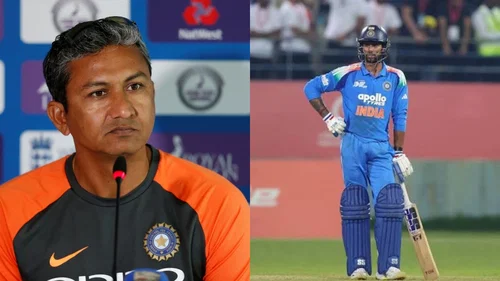
Tilak Varma could have been the hero of the match for the India A cricket crew. However because the crew misplaced to their arch rival Pakistan by a good margin, the skipper of the India A cricket crew is at the moment within the furnace.
Former India Nationwide Cricket Workforce player Sanjay Bangar slammed the India A captain Tilak Varma for the crew’s 48-run defeat towards Pakistan Shaheens in a Males’s Asia Cup <a href="https://cricket.international/ind-vs-pak-tilak-varma-and-abdul-samad-skip-handshake-in-rising-stars-asia-cup-conflict/" title="IND vs PAK: Tilak Varma and Abdul Samad skip handshake in Rising Stars Asia Cup conflict”>Rising Stars match on Sunday, November 22.
Tilak Varma scored a century but India A misplaced the match
Varma registered a century for the crew whereas chasing the 314-run target. However his knock was surprisingly very sluggish. There was a necessity to protect the wickets, but the sluggish pace of Varma’s innings additionally turned one of the causes behind the loss.
He scored 100 runs from 149 balls with seven 4s and one six earlier than dropping his wicket to Ahmed Daniyal. Tilak Varma, who’s properly often called an attacking batter, took 26 balls to claim his first 3 runs. After 36 balls, he was on 8 and had scored 22 off 52 deliveries.
Sanjay Bangar slams Tilak Varma’s sluggish batting technique
Sanjay Bangar noted that the sluggish batting of Tilak Varma might need affected the opposite batter on the crease as properly. The previous cricketer felt that because the skipper himself was not eager to take risks, the batter on the opposite end additionally was not enough to collect runs at a swift pace. Sanjay observed that Varma deliberate to satisfy the required run fee within the latter part of the innings.
“Tilak Varma made 3 runs off the primary 25 balls he faced, then within the subsequent 25 balls he scored 12-13 runs. So after playing 50 balls, should you attain 18-21, what’s the effect on the batter at the other end? Tilak regarded assured that he would make it up the end, but what effect does that have on the opposite batter? Will he take risks, or will he be pressured to take risks? That creates a wicket-taking alternative,” Sanjay Bangar, former India batting coach, said.
Hasan Nawaz played a crucial function behind the match outcome
The previous India batting coach said that the ultra-defensive approach created room for the Pakistan cricket crew to utilise the full 10-over quota of Hasan Nawaz. There was no second opinion that the wicket was supporting the spinners.
However there were sure methods to counter the spin assault to collect the runs in a daily fashion. A combination of right-hand and left-hand batters within the center may very well be helpful for the Indian cricket crew. Nawaz took three wickets in 10 overs for an economic system fee of 4.50.
“I feel the thing that India missed was that they allowed Hasan Nawaz to complete his 10 overs. On such a turning observe, actually an effort should have been made to use the right-left combination, which would have enabled better strike rotation. Then Pakistan wouldn’t have got the possibility to use Nawaz for all 10 overs,” the former cricketer continued.
Source: cricketaddictor.com
